
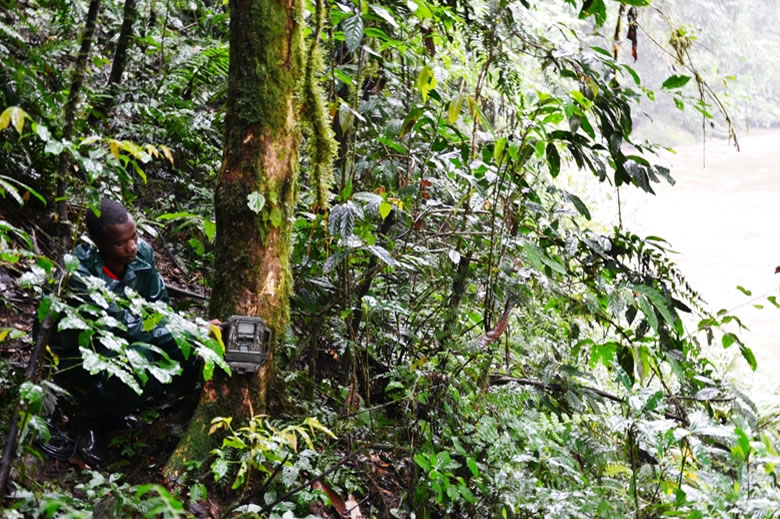
As we set off, through the tea plantations, past the abrupt transition to tropical forest (as is often the case around Bwindi), the heavens opened up on us with the force of a true tropical storm. We continued our wet, slippery journey down to the Ishasha river (along with numerous comical slips and disappearances down holes), in the hopes we might find what we were looking for… a picture of an otter!
Otters have previously been recorded in Bwindi between 1990s and 2000. A social study in 2000 by Andama Edward on the ‘Status and distribution of carnivores in Bwindi Impenetrable National Park’, identified that local people around Bwindi knew of two species of otter, the Clawless otter (Aonyx capensis) and the Spot necked otter (Lutra mavulicollis), however there has yet to be a camera trap photo to confirm this.
Frederick Ssali (ITFC’s research officer) is undertaking a study which aims to camera trap in areas not being done by ITFC’s TEAM project, investigate the ecology of Bwindi’s otters and other aquatic and semi aquatic animals, as well as open up the area to further research. The study, which started in 2001, also plans to use water quality as a factor that could influence the distribution and presence of the different species.
Setting up the camera traps
So far, the otter team have conducted six camera trapping sessions along the Ihihizo river at the ‘neck’ of Bwindi, but were unlucky and didn’t catch a glimpse of any otters. However, they still found an abundance of wildlife including the African Golden Cat, African Civet, Bush Tailed Porcupine and Yellow Backed Duiker. The team then changed their location to the larger Ishasha river (where we went) and have been camera trapping along its steep banks.
After 10 camera trapping sessions and still no sign of an otter (although an exiting glimpse of a long tailed pangolin), the team plans to move their study site somewhere closer to home (Ruhija).
Let hope that, in the future, we can report that the otters have finally been spotted!