
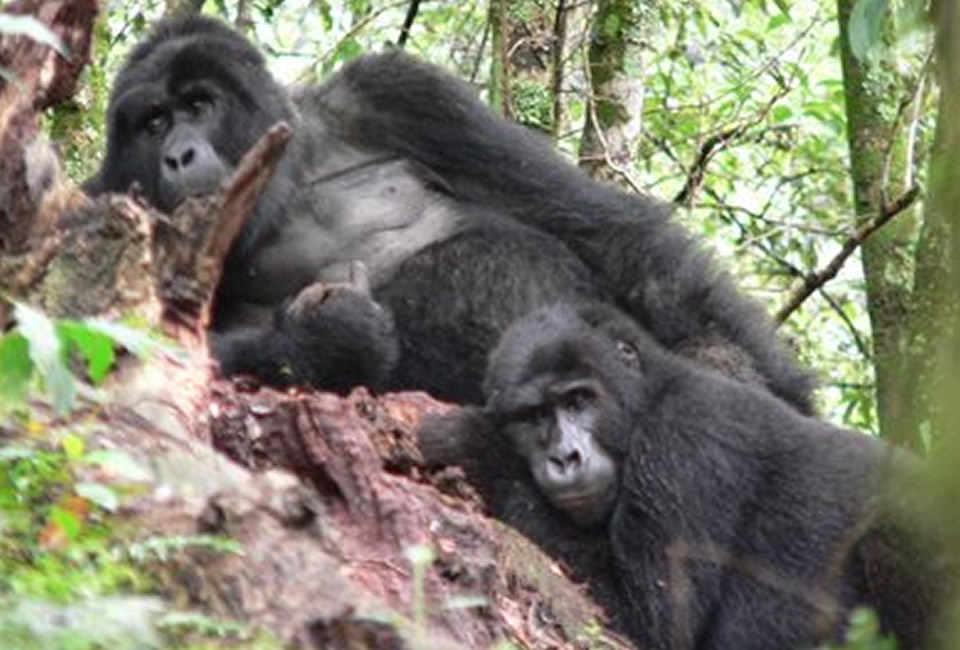
I spend a lot of my working time for ITFC on monitoring the Kyagurilo group. ‘What is that?’ you may ask. I’ll tell you.
The Kyagurilo is a mountain gorilla group that has been monitored daily since 1995. The group got its name from the area where its home range used to be, near Mubwindi Swamp in the centre of Bwindi quite near to ITFC.
Martha Robbins, from the Max Planck Institute (MPI) in Germany, has been carrying out a long term study of this group’s behaviour, feeding habits, ecology, sociology and home range. Every individual in the Kyagurilo group has a name. The names are given according to each animal according to their features and distinguishing marks; for example ‘Kakumu’, (kumu meaning ‘finger’ in Rukiga language), has a stiff finger that points up all the time; and ‘Binyindo’ means a big nose with a scar mark; and the name ‘Mugwere’ was given to a gorilla that looked sick (‘in a sick state’). That way we can remember their names more easily.
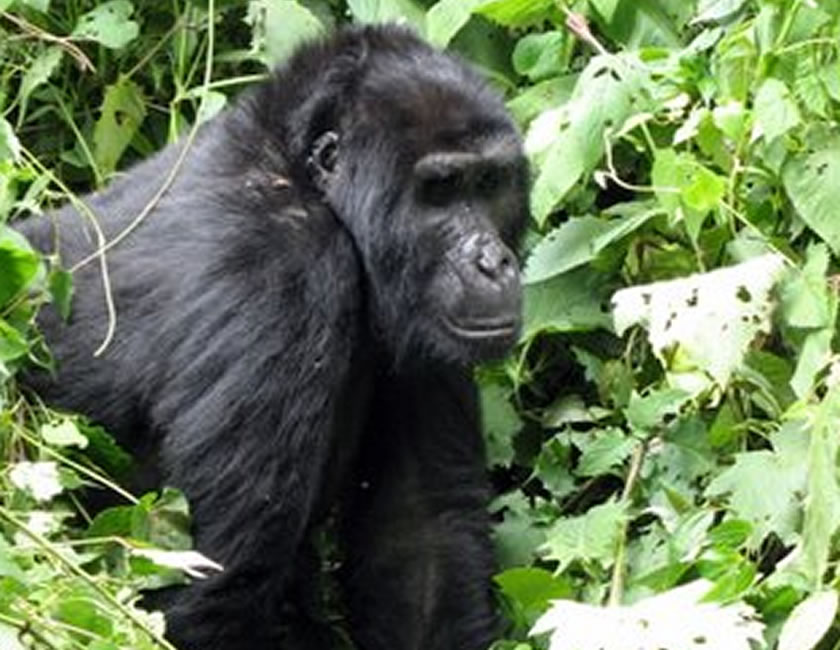
Sometimes some of the young males hide in the bushes and can jump out and grab you. They are playing but it has given me a fright several times. Indeed it is a serious matter: we have to try hard keep our distance to over 7 meter so as to avoid direct contact and to reduce the chance that the animals may catch any ilness from us (we are careful and we do not go to the field if we feel ill or have a cold). At times I like to see the infants playing and the adult females grooming the silverback during resting periods.
This group currently has 14 members; one dominant silverback, 5 adult females, 3 black-back males, 2 juveniles and 3 infants. There have been changes over the past years; in 2004, for example, the dominant silverback was over powered by a younger one and left the group after a heavy fight. But he had serious injuries from which he did not recover, and he died. Also, a young adult female left the group and joined another one and recently Kakumu left Kyagurilo group, with an infant. Black back males have left for shorter or longer periods, some came back, other live a solitary life. These changes are normal, (like in human groups?) and we record all of it.
My fellow field assistants and I continue to monitor this gorilla group daily. In another blog I will tell you how a day with the Kyagurilo group looks like.
This experience with mountain gorilla monitoring has helped the management of the park to habituate other gorilla groups and several are visited by tourists. Again it has helped me and my fellow field assistants to be involved in contributing to conservation activities.
Let’s join hands and save the mountain gorillas and their habitat.